Vitrified Tiles
Vitrified tiles from Morbi in double-charge, full-body, GVT and PGVT constructions, selected for the traffic level and installation the tile is actually going into.
At a glance
- Water absorption below 0.5%, typically under 0.1% on full body
- Sizes from 600x600 mm to 800x1600 mm and larger slabs
- Double charge, full body, GVT and PGVT constructions
- Rectified edges with joint widths down to 2 mm
- One 20ft container minimum, mixed designs negotiable
Buying vitrified tiles from Morbi
Morbi in Gujarat produces the overwhelming majority of India's ceramic and vitrified tile output, and it is one of the largest tile manufacturing clusters in the world. For an importer, that concentration is both the opportunity and the risk: there are hundreds of plants within a short radius, their quality and consistency vary enormously, and a price quoted without a specification can mean almost anything. VP Global Exim buys in Morbi as a merchant exporter with our own quality control, which means we select the plant for your specification rather than sending your enquiry to whoever answers first.
Vitrified tile is defined by its water absorption rather than by its appearance. A tile qualifies as vitrified when absorption is below 0.5 percent, and full-body and double-charge products typically measure below 0.1 percent. That low porosity is what gives the tile its strength, stain resistance, frost resistance and suitability for heavy traffic, and it is the property that separates a genuine vitrified tile from a glazed ceramic tile that merely looks similar in a photograph.
We supply the full range of vitrified constructions: double-charge tiles where two layers of pigmented powder are pressed together to give a thick wear surface, full-body tiles where colour runs through the entire thickness, glazed vitrified tiles known as GVT where a digitally printed glaze sits on a vitrified body, and polished glazed vitrified tiles known as PGVT where that glazed surface is then polished. Each has a different cost, appearance and appropriate application, and choosing correctly matters more than negotiating the last few cents.
Understanding double charge, full body, GVT and PGVT
Double-charge tiles are pressed with two layers of powder, the top layer typically three to four millimetres thick, and then polished. Because the wear surface is thick and homogeneous, they tolerate heavy foot traffic and aggressive cleaning very well, and minor surface damage can often be repolished. Their limitation is design: patterns are formed in powder rather than printed, so the range is restricted to salt-and-pepper, granite-like and simple linear effects. For commercial corridors, showrooms, airports and institutional projects, they remain the most durable practical choice.
Full-body vitrified tiles carry the same colour and composition through the entire body. They are the most durable option available, tolerate deep abrasion without changing appearance, and can be used in industrial and heavy commercial environments. They are also the most expensive per square metre and the heaviest, and their design range is the most restricted. Where a specification calls for a tile that will still look correct after fifteen years in a public building, this is usually the honest answer.
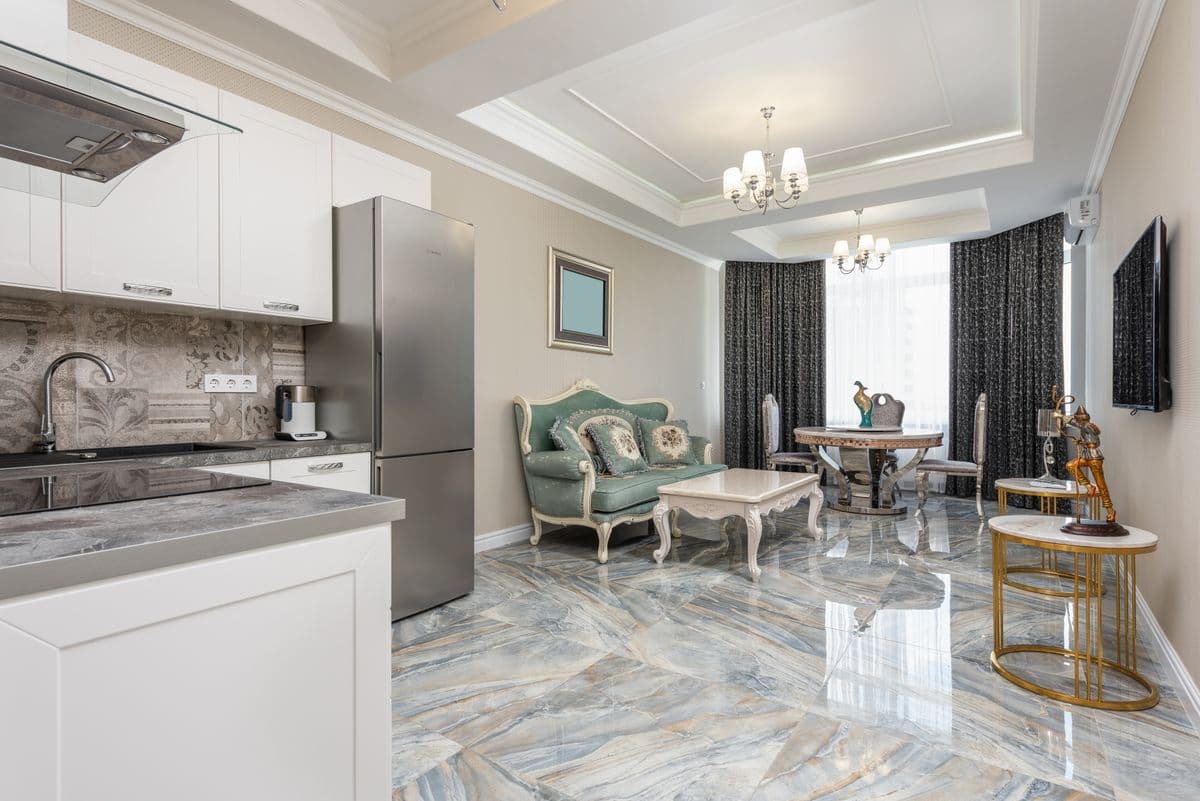
Glazed vitrified tiles, GVT, place a digitally printed glaze over a vitrified body. Because the design is printed, the range is effectively unlimited: marble, stone, wood, cement, concrete, terrazzo, fabric and abstract designs are all available at high visual fidelity, with multiple faces per design to avoid visible repetition. The wear surface is the glaze, so its durability depends on glaze hardness and thickness, and its abrasion resistance class must be matched to the application rather than assumed.
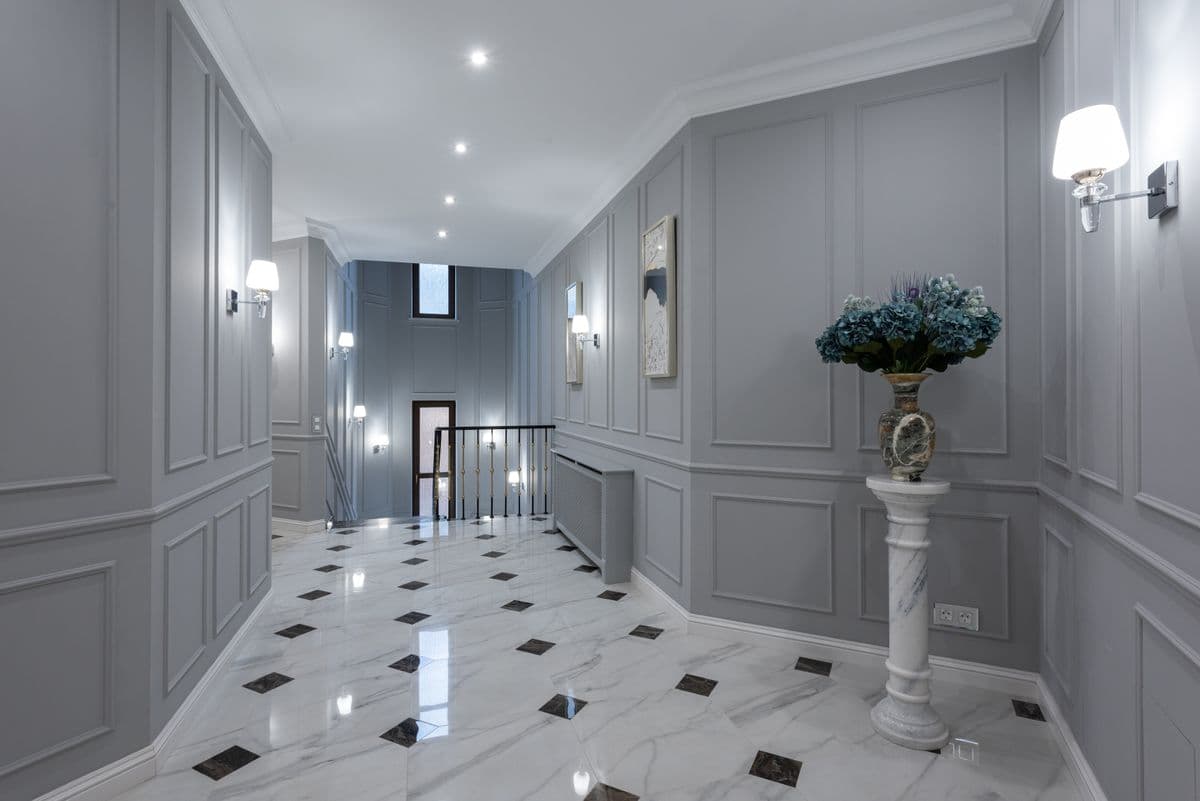
Polished glazed vitrified tiles, PGVT, are GVT tiles whose glaze has been polished to a high gloss. They deliver the closest available imitation of polished marble at a fraction of the cost and are extremely popular for residential floors and hotel interiors. The polishing process opens microscopic pores in the glaze, so PGVT is more susceptible to staining than unpolished GVT unless it carries a nano or anti-stain surface treatment, which we specify for kitchen, dining and commercial applications.
Sizes, thickness and rectification
Size availability from Morbi is extensive and continues to expand. Common floor sizes include 600 by 600, 600 by 1200, 800 by 800, 800 by 1200, 800 by 1600, 900 by 1800 and 1200 by 1200 millimetres, along with plank formats such as 200 by 1200 and 200 by 1000 for wood-look designs, and large slabs beyond 1600 millimetres. Wall and small-format sizes, mosaic sheets, step and riser sets, skirting and trim pieces are available to match most floor designs.
Thickness typically runs from 8.5 to 10.5 millimetres on standard vitrified formats and 12 millimetres or more on larger sizes and heavy-duty products. Thickness is not a proxy for quality, but it must be adequate for the size: a large-format tile that is too thin is difficult to handle, more likely to break in transit and more likely to fail on an imperfect substrate. We match thickness to size and application rather than quoting the thinnest available option to reduce freight weight.
Rectification is the process of mechanically grinding tile edges after firing so every piece is dimensionally identical. Rectified tiles can be laid with joints as narrow as two millimetres, which is essential for a seamless marble-look or large-format installation. Non-rectified tiles carry a wider dimensional tolerance and need wider joints. We state clearly whether a product is rectified, because a specification asking for a two-millimetre joint on a non-rectified tile cannot be installed as intended.
Dimensional properties are verified rather than assumed. We check length and width tolerance, thickness variation, straightness of edges, rectangularity and surface flatness against the applicable standard, and on large formats we pay particular attention to warpage, since a slab that is out of flat is very difficult to install without lippage. On rectified large formats these checks matter more than almost anything else in the specification.
Technical performance and testing
Tile performance is measurable, and we test rather than repeat claims. Water absorption is measured to confirm the vitrified classification. Breaking strength and modulus of rupture are tested to confirm structural adequacy for the intended traffic and thickness. Abrasion resistance is assessed by the PEI class for glazed surfaces and by deep abrasion volume for unglazed products, and we match the class to the application: light residential, general residential, light commercial, or heavy commercial and public traffic.
Surface properties tested include slip resistance, reported as a coefficient of friction or as an R rating depending on the standard your market uses, stain resistance, chemical and acid resistance, thermal shock resistance, frost resistance for external applications in cold climates, and colour fastness to light. Where your project specification names a standard - the ISO 13006 and ISO 10545 test families, an ANSI or EN standard, or a national building code requirement - we route the order to a plant that can supply testing against it and provide the reports.
Slip resistance deserves particular attention because it is the property most often specified incorrectly. A high-gloss polished tile is not suitable for a wet area regardless of how good it looks in the showroom, and specifying one for a bathroom floor or pool surround creates a genuine safety liability. We will tell a buyer plainly when a selected product is unsuitable for the stated application and propose an anti-skid alternative in a comparable design.
Test reports are supplied with the shipment where they have been specified, and we distinguish clearly between a plant's generic type-test report and testing carried out on your production lot. For project work where a consultant will review submissions, lot-specific testing is usually what is actually required, and it needs to be arranged before production rather than requested after loading.
Shade variation, batch control and quality grading
Shade variation is the most common complaint in tile importing, and it is largely preventable through batch discipline. Tiles are produced in firing batches, and colour shifts measurably between batches even in a well-controlled plant. We therefore confirm that the full quantity for a design is produced within one batch wherever possible, mark batch and shade codes on every carton, and separate shades so an installer can plan rather than discover the difference mid-floor.
Where an order is too large for a single batch, we say so in advance and agree how it will be handled: separating batches by area or floor, holding a reserve from the first batch for cut pieces and repairs, or accepting the variation as part of the design intent. What we do not do is ship mixed batches without marking, which is how an installation ends up with a visible line across a room.
Quality grading is stated explicitly. Morbi plants grade output as premium, commercial and economy, and the difference lies in dimensional tolerance, surface defects, shade consistency and how many pieces per box are acceptable as seconds. A price that looks unusually attractive is very often a lower grade, and the difference appears at the installer's hands rather than on the invoice. We quote the grade we are offering, inspect against it, and refuse to substitute a lower grade to protect a price.
Pre-shipment inspection covers dimensional checks on sampled pieces, surface defect inspection against an agreed acceptance level, shade comparison against the approved sample under standard lighting, verification of design and size against the order, carton count and marking verification, and pallet condition. Buyers are welcome to appoint their own third-party inspector, and we coordinate access and timing.
Packing, loading and freight economics
Tile is heavy and low-value per kilogram, so freight is a large share of the landed cost and loading efficiency directly affects your economics. Tiles are packed in export-grade cartons with the piece count printed, palletised on wooden pallets, strapped and shrink-wrapped or hooded, with corner protection and edge protection on large formats. Pallet heights are planned so containers load to weight rather than leaving payload unused.
A 20ft container is the standard unit for tile because weight rather than volume limits the load, and a 20ft container typically carries in the region of 22 to 26 tonnes depending on the destination's road weight limits. We plan the loading against the destination's legal limits rather than the container's maximum, because a container loaded above the road limit at destination becomes an expensive de-stuffing problem.
Mixed-design and mixed-size containers are entirely workable and are how most importers actually buy. We consolidate several designs, sizes and even categories into one container with a clear loading plan and packing list so goods can be checked off on arrival. Where you want tiles consolidated with sanitary ware, building materials or other categories, that is a routine part of our merchant export service and it is usually how smaller buyers reach container economics.
Breakage is managed rather than accepted. Loading pattern, pallet strapping, void filling, dunnage and load securing all affect arrival condition, and we specify them rather than leaving them to the loader. We also advise buyers to order a small percentage above the installed requirement to cover cuts, wastage and any transit breakage, and to keep a reserve from the same batch for future repairs, because a matching replacement will not be available in two years.
Documentation, standards and market compliance
Export documentation is issued as a complete package: commercial invoice, packing list with design, size, grade, batch and piece counts, certificate of origin, bill of lading, insurance certificate where requested, and inspection and test reports where specified. Where your market requires a preferential-origin certificate or a specific conformity document, we confirm the requirement at order stage and build it into the file.
Several markets require conformity marking or certification before tiles can be sold, and the requirement varies considerably. We confirm what your destination market requires and route the order to a plant holding the relevant certification, rather than shipping and discovering the issue at customs. Where a required certification is not held by any suitable plant for your product and price, we tell you that rather than proceeding.
Labelling and carton marking are set to your requirement: your brand and design name, size and thickness, piece count and square-metre coverage per carton, shade and batch code, grade, country of origin, barcode, and any handling or safety marking. Retail-ready cartons with your own branding and design imagery are available where you sell through a showroom or trade counter.
Selecting the right vitrified tile with us
The most useful conversation is about the application rather than about the product. Tell us where the tile is going - residential floor, hotel lobby, retail unit, office corridor, external terrace, industrial area - along with the expected traffic, the wet or dry condition, the cleaning regime, the joint width you want and the visual direction, and we will propose the construction, size, finish and abrasion class that fits, with prices for two or three realistic options rather than one.
For project buyers we can work directly from a consultant's specification, matching each clause and stating explicitly where an offered product meets, exceeds or falls short of it. Where a specification is internally inconsistent - a polished surface with a wet-area slip requirement is the classic example - we raise it before quoting rather than submitting a product that will be rejected at review.
Samples are supplied before commitment. We send physical samples of the shortlisted designs, and for larger orders we can supply a full box so an installer can lay a small area and judge shade variation, joint behaviour and lippage risk on a real substrate. That is a much better basis for a decision than a single tile held up in an office.
Vitrified Tiles specifications
| Constructions | Double charge, full body, GVT and PGVT |
|---|---|
| Water absorption | Below 0.5%; typically under 0.1% on full body and double charge |
| Sizes | 600x600 to 800x1600 mm, 900x1800, 1200x1200, plank formats and larger slabs |
| Thickness | 8.5-10.5 mm standard; 12 mm and above on large formats and heavy-duty products |
| Edges | Rectified for 2 mm joints, or non-rectified with standard joint widths |
| Abrasion | PEI class matched to application on glazed surfaces; deep abrasion volume on unglazed |
| Testing | Water absorption, modulus of rupture, abrasion, slip resistance, stain and chemical resistance, frost resistance |
| Surface treatment | Nano and anti-stain coating on polished surfaces; anti-skid finishes for wet areas |
| MOQ | One 20ft container; mixed designs and sizes negotiable within a container |
| Lead time | 20-35 days from confirmed order and approved samples, subject to design availability and batch scheduling |
Made to your requirements
- Design and shade selection with physical samples
- Branded cartons and retail-ready packaging
- Mixed-design and mixed-category container consolidation
- Anti-skid and anti-stain surface treatment specification
- Lot-specific testing for project submissions
- Batch reservation for phased project deliveries
Where our vitrified tiles is used
Typical buyer profiles and end uses we supply into.
Vitrified Tiles export questions
The questions buyers ask most often before placing a first order.
What is the difference between GVT and PGVT?
Both are glazed vitrified tiles with a digitally printed design over a vitrified body. PGVT is the same product with the glaze polished to a high gloss, which gives a convincing polished-marble appearance but opens microscopic pores in the glaze and makes it more stain-prone. For kitchens, dining areas and commercial use we specify a nano or anti-stain treatment on PGVT, or recommend unpolished GVT.
How do you prevent shade variation between cartons?
By batch discipline. We confirm the full quantity for a design is produced within one firing batch wherever possible, mark batch and shade codes on every carton, and separate shades so the installer can plan. Where an order is too large for one batch, we tell you in advance and agree how it will be handled rather than shipping mixed batches unmarked.
Which tile should I use for a wet area?
Not a polished one. High-gloss polished surfaces are unsuitable for wet areas regardless of appearance, and specifying one for a bathroom, pool surround or external area creates a real safety liability. We will propose an anti-skid finish with an appropriate coefficient of friction or R rating in a comparable design, and we will say plainly when a selected product does not suit the stated application.
What does rectified mean and do I need it?
Rectified tiles have their edges mechanically ground after firing so every piece is dimensionally identical, which allows joints as narrow as two millimetres. You need it for seamless marble-look and large-format installations. Non-rectified tiles carry wider dimensional tolerance and need wider joints, so a specification asking for a 2 mm joint on non-rectified tile cannot be installed as drawn.
How much tile fits in a container?
Tile loads to weight, not volume. A 20ft container typically carries 22 to 26 tonnes depending on the destination's road weight limits, which we plan against rather than against the container maximum. Mixed designs, sizes and even other product categories can be consolidated in one container with a clear loading plan and packing list.
Can I get samples before ordering?
Yes. We supply physical samples of shortlisted designs, and for larger orders we can send a full box so your installer can lay a small area and judge shade variation, joint behaviour and lippage risk on a real substrate. Deciding from a full box is considerably more reliable than deciding from a single tile.
Request a quote: Vitrified Tiles
Send your specification, quantity and destination market. We confirm feasibility, quote with a lead time and propose a sampling plan so your first order is judged on an approved sample.
- Response within 24 hours
- Samples before bulk commitment
- Full export documentation handled
Enquire about Vitrified Tiles
Pre-filled for this product - just add your details.