Sheet Metal
Laser-cut, punched, bent and welded sheet metal fabrications in steel, stainless steel and aluminium, finished and supplied to your drawing as single parts or complete enclosures.
At a glance
- Fibre laser cutting from 0.5 mm to 20 mm and beyond
- CNC press-brake bending with offline programming
- MIG, TIG, spot and stud welding with fixtures
- Powder coating, galvanising, plating and passivation
- Enclosures, brackets, panels, frames and chassis
Fabrication capability across the full route
Sheet metal work is deceptively easy to quote and genuinely difficult to deliver consistently, because the finished dimension of a folded part depends on material thickness tolerance, bend radius, tooling condition and the operator's setup as much as on the flat pattern. VP Global Exim supplies sheet metal fabrications from India through units that hold the whole route in-house - cutting, forming, joining, finishing and assembly - so responsibility for the finished dimension sits in one place rather than being divided between a cutter and a bender.
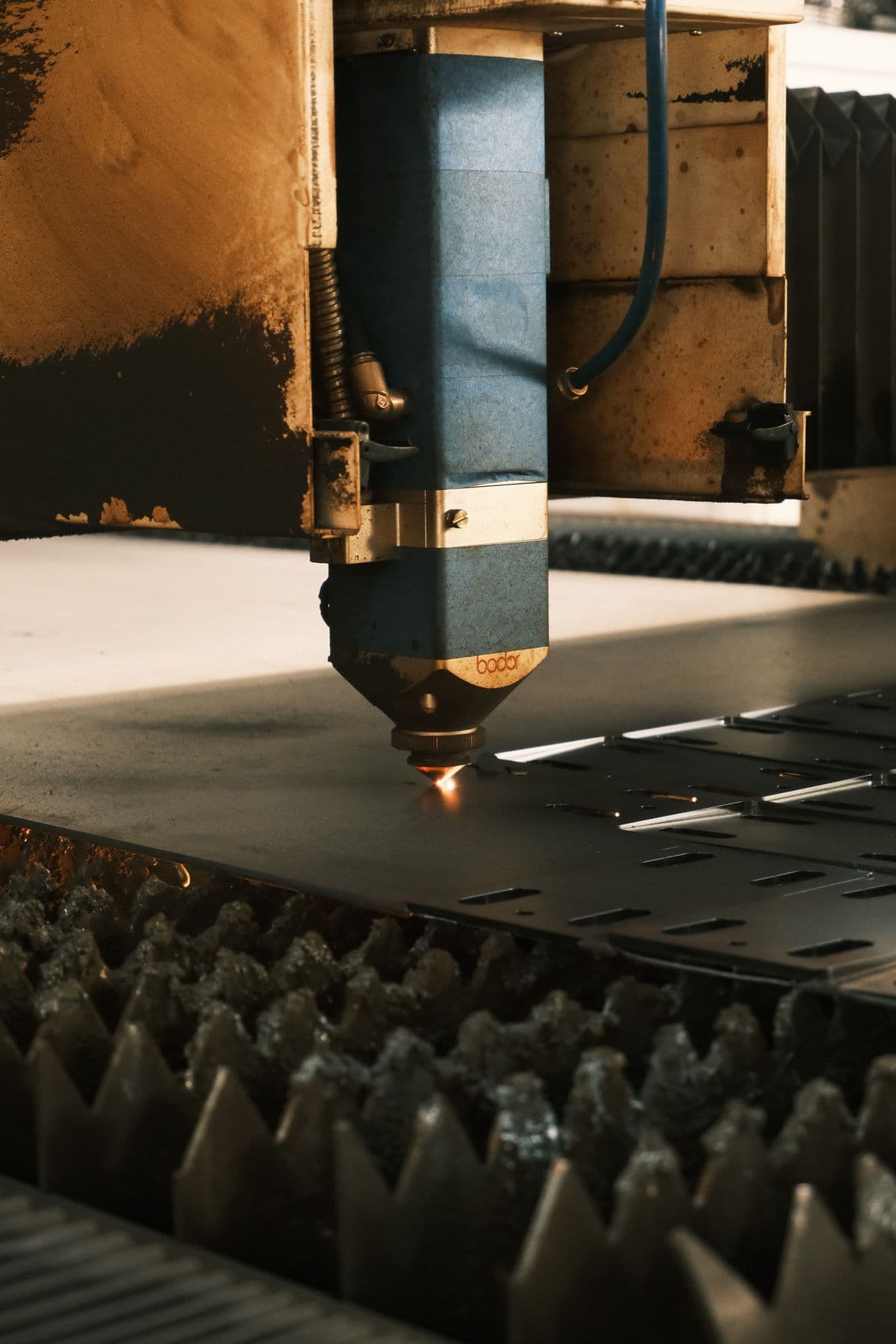
Cutting capability includes fibre laser cutting for steel, stainless steel, aluminium, brass and copper, CO2 laser for thicker mild steel sections, CNC turret punching for high-volume repeat parts with formed features, plasma cutting for heavy plate, and shearing and sawing for simple straight-cut work. Fibre laser handles thin gauge from around half a millimetre through to 20 millimetres and heavier depending on machine power and material.
Forming and joining capability includes CNC press-brake bending with offline programming and multiple tool stations, rolling and section bending, hydraulic pressing and deep drawing on suitable geometry, hardware insertion for self-clinching studs, nuts and standoffs, MIG and TIG welding, spot and projection welding, stud welding, riveting and clinching, tapping and countersinking, and dressing and finishing of welds to the standard your drawing specifies.
Typical products include electrical and control enclosures, cabinets and racks, machine guards and covers, brackets, mounting plates and chassis, ducting and trays, hoppers and chutes, panels and fascias, frames and skids, tanks and vessels for non-pressure service, and general fabricated assemblies. Volumes run from single prototype items to repeat production in tens of thousands.
Materials, gauges and finishing
Material selection is driven by the service environment and the finish. Cold-rolled and hot-rolled mild steel is the default for painted and powder-coated work. Pre-galvanised and galvannealed steel is used where cut-edge corrosion is acceptable and cost matters. Stainless steel in austenitic grades is specified for corrosion resistance, hygiene and appearance, with brushed, mirror and patterned finishes available. Aluminium in the common sheet alloys is used where weight matters, and brass and copper for electrical and decorative applications.
Gauge tolerance is a real source of dimensional error and we manage it rather than ignoring it. Sheet is bought to a specified thickness tolerance, verified on receipt, and bend deductions are calculated for the actual material rather than from a generic table. On tight-tolerance assemblies we hold material from a single coil or lot through the production run so bend allowances stay constant, because a change of 0.1 millimetres in thickness moves the finished dimension of a multi-bend part measurably.
Finishing options cover powder coating in your RAL, BS or Pantone-matched colour with a specified film thickness and cure schedule, wet painting including two-pack and marine-grade systems, hot-dip galvanising, zinc and zinc-nickel electroplating, passivation and electropolishing of stainless steel, anodising of aluminium, chromate conversion coating, and mechanical finishes including grinding, brushing, graining and polishing. Pre-treatment before coating is specified - degreasing, phosphating, chromate-free conversion or blasting - because coating adhesion failures almost always originate in pre-treatment rather than in the coating itself.
Coating quality is verified rather than assumed. Film thickness is measured at defined points, adhesion is checked by cross-hatch or pull-off test, cure is verified by solvent rub, and salt-spray testing is arranged where a corrosion-resistance hour rating is specified. Colour is matched against your physical reference and approved on a coated sample panel, because a RAL number alone does not fix gloss level or texture.
Tolerances, flat patterns and dimensional control
Sheet metal tolerances behave differently from machined tolerances, and quoting realistically means saying so. Cut-edge dimensional accuracy from a fibre laser is typically well within a few tenths of a millimetre. Formed dimensions accumulate tolerance with each bend, so a part with six bends cannot hold the same tolerance across its overall length as a part with one. Where a drawing applies a uniform tight tolerance across a multi-bend part, we raise it at quotation and propose either a datum-based tolerance scheme or a change in the joining method.
Flat patterns are developed from your three-dimensional model or two-dimensional drawing using bend deductions calculated for the actual material, thickness and tooling, not from a default k-factor. Where you supply a flat pattern yourself, we check it against the folded geometry and tell you if it will not produce the intended part, which is a common problem with patterns developed on a different material assumption.
First article inspection is carried out on every new part with a dimensional report against the ballooned drawing, and formed parts are checked in a fixture or against a gauge where geometry makes conventional measurement unreliable. On welded assemblies, welding fixtures are made to control distortion, and the fixture design is part of the first-article approval because the assembly's dimensions are a property of the fixture as much as of the components.
Welding distortion is planned for rather than corrected afterwards. Weld sequence, intermittent versus continuous welding, fixture clamping, heat input control and post-weld straightening or stress relief are all specified where the assembly is distortion-sensitive. Where a drawing specifies both a tight flatness requirement and continuous welding on a thin panel, we point out the conflict rather than delivering a bowed panel.
Welding, joining and structural integrity
Welding is specified rather than left to the shop floor. We document process, filler material, joint preparation, weld size and type, weld location and length, and finishing requirement for each joint. Where the assembly is structural or safety-related, welding is carried out to a qualified procedure by qualified welders, with procedure and qualification records supplied. Weld symbols on your drawing are read and applied as drawn; where the symbols are ambiguous or a weld is inaccessible as drawn, we raise it as a query before fabrication.
Weld inspection is matched to the application. Visual inspection against a written acceptance standard is the baseline, covering undercut, porosity, spatter, arc strikes, weld profile and size. Beyond that we arrange dye penetrant and magnetic particle inspection for surface defects, ultrasonic and radiographic examination on thicker structural welds, and leak testing on enclosures and tanks that must be sealed. Weld appearance requirements are agreed with a physical reference sample where the weld is visible in the finished product.
For enclosures and cabinets that must meet an ingress protection rating, sealing is treated as a design and process requirement. Gasket type and compression, continuous weld placement, door and panel flatness, hinge and latch alignment, and cable-entry sealing all determine the outcome, and the rating is verified by test on a sample where the buyer requires evidence rather than a claim.
Hardware, sub-assembly and kitting
Most sheet metal parts arrive at their final form only after hardware and sub-assembly work. We insert self-clinching nuts, studs and standoffs, install rivet nuts and threaded inserts, fit hinges, latches, locks, handles, gaskets and seals, apply labels, nameplates and screen-printed graphics, install cable glands, grommets and ventilation grilles, and assemble multi-part frames and enclosures complete. Where electrical assembly is required, we can source and fit din rails, mounting plates, earth studs and bonding straps.
Buyers frequently prefer to receive a kit rather than an assembly, particularly where final assembly happens at their own plant or where shipping volume matters. We can supply flat-packed kits with all components, hardware and fasteners bagged and labelled, an assembly drawing included, and cartons marked so the kit is complete on arrival. Kitting is checked against a bill of materials at packing, and a missing fastener in a kit is treated as a shortage rather than a trivial omission.
Where an assembly includes bought-out components - fans, filters, locks, castors, gaskets, extrusion sections - we can source them locally against your specification or fit free-issue items you supply. Locally sourced components are approved on sample before bulk, and we state clearly whether a component is the brand you specified or an equivalent, with the equivalent's specification supplied for your approval.
Prototyping, volume and tooling economics
Sheet metal is the most prototype-friendly of the engineering categories, because laser cutting and press-brake forming require no part-specific tooling. A prototype can be produced from the same material and by the same route as production, which makes early samples genuinely representative. We quote prototypes at their real cost, with setup and programming shown separately so you can see what falls away at volume.
At higher volumes the economics change and we plan for it. Turret punching with formed features can replace laser cutting where the part suits it, dedicated bending tools and back-gauge fixtures reduce setup and improve repeatability, welding fixtures reduce cycle time and distortion, and nesting is optimised across the order to improve material yield. Material utilisation is worth real money in sheet metal, and we nest across parts within an order rather than one part at a time.
Where volumes justify hard tooling - deep-drawn parts, high-volume pressed brackets - we quote press tooling with its cost, ownership, expected life and refurbishment terms stated. Tooling you pay for belongs to you and is released on request. We say plainly when a proposed tooling investment will not pay back at your stated volume, because the honest answer sometimes is that laser and bend is cheaper for the life of the programme.
Packing, protection and shipping
Sheet metal is bulky, easily dented and easily scratched, and packing determines what condition it arrives in. Coated and finished surfaces are protected with peelable protective film, foam, corner protection and interleaving. Parts are separated so painted or brushed surfaces cannot contact one another. Fabricated assemblies are braced internally where panels could flex, and enclosures are packed with doors secured and glazing protected.
Heavier and larger items ship in ISPM 15 compliant wooden crates or on strapped skids designed so the load path runs through the structure rather than through a panel. Stackability is designed into the crate rather than left to the terminal. Where a shipment is nested or flat-packed to save volume, protective interleaving is specified so the volume saving does not become a damage cost.
Every package is labelled with part number, revision, quantity, order reference and weight, and cartons or crates are marked for orientation and lifting points where relevant. Export documentation includes commercial invoice, packing list, certificate of origin, material test certificates, coating and weld certification where applicable, dimensional and first article reports, and the transport document. Shipping is quoted on your preferred Incoterm, and sheet metal work consolidates readily with machined parts and assemblies in a single container.
Quoting a fabrication accurately
To quote sheet metal properly we need the three-dimensional model or a fully dimensioned drawing, the material and gauge, the finish specification including colour reference and film thickness, welding and joining requirements, hardware and bought-out component specification, tolerance requirements with datums, and quantity per batch and per year. A flat pattern alone is not enough, because the folded geometry determines whether the part is manufacturable as drawn.
We come back with a quotation showing piece price at the stated quantities, setup and programming cost, any tooling or fixture cost with ownership terms, lead time for first article and production, the inspection and documentation scope, and a written query list on anything in the drawing that is ambiguous, conflicting or disproportionately expensive. Design-for-manufacture suggestions are offered with the cost saving quantified so your engineering team can accept or decline on evidence.
If you are currently buying the part elsewhere and want a comparable source, send the current part along with the drawing. Comparing a physical sample against the drawing frequently reveals that what you are receiving today differs from what the drawing specifies, and knowing which of the two you actually want is the most useful thing to establish before production starts.
Sheet Metal specifications
| Cutting | Fibre and CO2 laser, CNC turret punching, plasma, shearing and sawing; 0.5-20 mm and heavier |
|---|---|
| Forming | CNC press-brake bending with offline programming, rolling, section bending, pressing, deep drawing |
| Joining | MIG, TIG, spot, projection and stud welding, riveting, clinching, self-clinching hardware insertion |
| Materials | Cold and hot-rolled mild steel, pre-galvanised, stainless steel, aluminium, brass, copper |
| Finishes | Powder coating to RAL or BS, two-pack paint, galvanising, zinc plating, passivation, electropolishing, anodising |
| Coating checks | Film thickness, cross-hatch and pull-off adhesion, solvent-rub cure, salt-spray on request |
| Inspection | First article dimensional report, fixture and gauge checking on formed parts, weld visual and NDT |
| Assembly | Hardware insertion, sub-assembly, bought-out component fitting, flat-packed kitting with bill of materials check |
| MOQ | Prototype single pieces upward; repeat production from 50 pieces per part, with volume programmes to tens of thousands |
| Lead time | 2-4 weeks for first article; 4-7 weeks for production including finishing and assembly |
Made to your requirements
- Flat-pattern development from your model with material-specific bend deductions
- Powder coat colour matched and approved on a coated panel
- Welding fixtures designed for distortion control
- Hardware insertion and full sub-assembly
- Bought-out component sourcing or free-issue fitting
- Flat-packed kits with assembly drawings for on-site build
Where our sheet metal is used
Typical buyer profiles and end uses we supply into.
Sheet Metal export questions
The questions buyers ask most often before placing a first order.
Why can't you hold the same tolerance across a multi-bend part?
Formed dimensions accumulate tolerance with each bend, so a six-bend part cannot hold the same overall-length tolerance as a single-bend part. Cut-edge accuracy from a fibre laser is within a few tenths of a millimetre, but bend deduction varies with material thickness tolerance and tooling condition. Where a drawing applies a uniform tight tolerance, we propose a datum-based scheme or a different joining method instead of accepting an order we cannot meet.
Can you work from a flat pattern I already have?
Yes, but we check it against the folded geometry first. Flat patterns developed on a different material or thickness assumption produce the wrong finished part, which is a common and expensive surprise. We calculate bend deductions from the actual material, thickness and tooling, and we tell you if your pattern will not produce the intended dimensions.
How is powder coating quality verified?
Film thickness is measured at defined points, adhesion tested by cross-hatch or pull-off, and cure verified by solvent rub, with salt-spray testing arranged where an hour rating is specified. Colour is approved on a coated sample panel against your physical reference rather than on a RAL number alone, since the number does not fix gloss level or texture. Pre-treatment is specified because adhesion failures usually originate there.
Do you supply assembled enclosures or flat-packed kits?
Both. We can supply enclosures fully assembled with hardware, gaskets, hinges, latches, glands and graphics fitted, or flat-packed kits with all components and fasteners bagged, labelled and checked against a bill of materials with an assembly drawing included. Kits reduce shipping volume considerably where you do final assembly yourself.
Can you meet an ingress protection rating on an enclosure?
Yes, treated as a design and process requirement rather than a claim. Gasket type and compression, continuous weld placement, panel flatness, hinge and latch alignment and cable-entry sealing all determine the result, and we verify the rating by test on a sample where you require evidence. We will tell you if a drawing's construction cannot achieve the rating stated on it.
Is prototype sheet metal representative of production?
More so than in any other engineering category, because laser cutting and press-brake forming need no part-specific tooling. A prototype runs on the same machines, material and route as production. We quote prototypes at real cost with setup and programming shown separately, and we tell you what changes at volume, such as a move to turret punching or dedicated bend tooling.
Request a quote: Sheet Metal
Send your specification, quantity and destination market. We confirm feasibility, quote with a lead time and propose a sampling plan so your first order is judged on an approved sample.
- Response within 24 hours
- Samples before bulk commitment
- Full export documentation handled
Enquire about Sheet Metal
Pre-filled for this product - just add your details.