Submersible Pumps
Borewell and openwell submersible pump sets selected against your actual head and flow requirement, with performance curves and test evidence rather than a headline rating.
At a glance
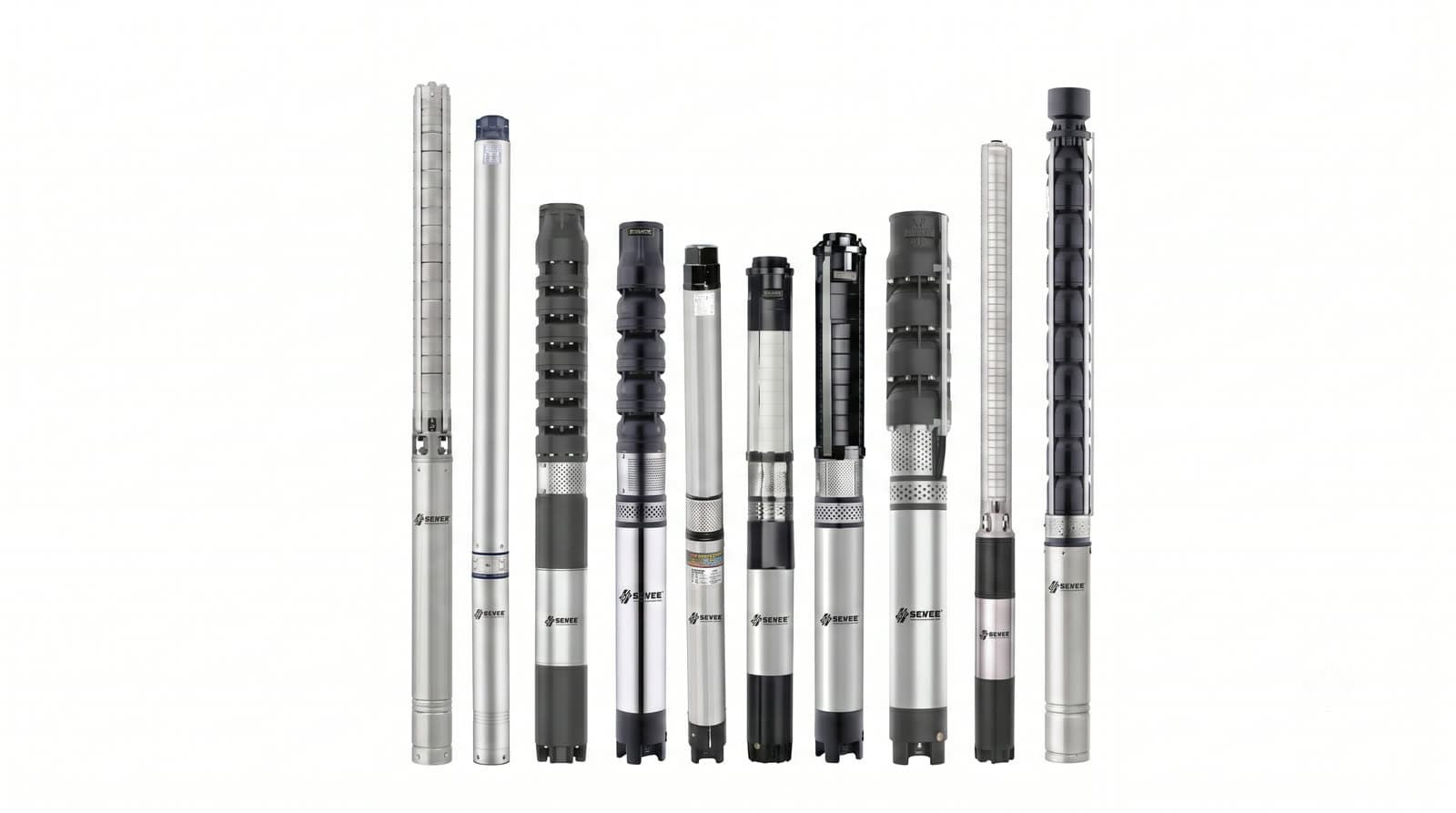
- 4 inch, 6 inch and larger borewell pump sets
- Openwell submersible pumps for tanks and shallow sources
- Stage count and impeller selection to your head requirement
- Performance tested with head-flow curve supplied
- Water-filled and oil-filled motor options
Selecting a submersible pump properly
Submersible pumps are almost always bought incorrectly, and the reason is that buyers specify horsepower when the pump is actually defined by head and flow. A 3 horsepower pump can be built to deliver a large flow at low head or a small flow at high head, and the two are entirely different products with the same nameplate power. VP Global Exim specifies submersible pumps from head and flow, then confirms the power that follows, which is the order the physics actually works in.
We export borewell submersible pump sets in 4 inch, 6 inch and larger bore diameters, openwell submersible pumps for tanks, sumps and shallow sources, and matched pump and motor sets supplied ready to install. Ratings run from fractional units for domestic and small irrigation use through the mainstream agricultural range and up to larger sets for community water supply and higher-lift irrigation.
The applications are mainly agricultural irrigation from borewells and openwells, drinking water supply for villages and small communities, domestic and building water supply, tank and sump transfer, dewatering, and industrial water supply. Each has a different duty pattern, and duty pattern matters: a pump running continuously for irrigation has different requirements from one that starts and stops many times a day for a building supply.
Head, flow and the duty point
The total head a pump must develop is the sum of the static lift from the water level to the discharge point, the friction loss in the pipework and fittings, and any pressure required at the outlet. Buyers routinely calculate the static lift and ignore friction loss, which on a long delivery line can be a substantial share of the total. Undersizing on head produces a pump that delivers far less water than expected, or none at all.
Water level in a borewell is not a single number. There is a static level when the pump is off and a drawdown level when it is running, and the drawdown can be considerably deeper. The pump must be selected for the drawdown level and set below it with adequate submergence, and the borewell's yield must be sufficient for the pump's flow, otherwise the pump will pull the water level down to its inlet and run dry. We ask for static level, drawdown level, borewell yield and depth, because a pump specified without them is a guess.
We supply a head-flow performance curve for every pump, showing the flow delivered across the head range with the efficiency and power curves. The curve is what allows a proper selection, because it shows how the pump behaves when conditions differ from the design point - which they always do. A pump selected at its best efficiency point for the actual duty will use less energy and last longer than one selected on a headline figure.
Stage count is how a submersible pump is matched to head. Each stage adds head at roughly constant flow, so a high-lift pump has many stages and a high-flow low-lift pump has few. This means the pump is genuinely built for your duty rather than adapted to it, and it also means the specification needs to be right before manufacture. We confirm the stage count and impeller selection in the quotation so it is documented rather than assumed.
Construction, materials and wear resistance
Submersible pump construction determines service life, and the critical factor is usually abrasion. Groundwater frequently carries sand, and sand is what destroys submersible pumps: it wears impellers and diffusers, scores shafts and bearings, and erodes clearances until performance collapses. Where sand content is significant, material selection has to reflect it rather than relying on a standard build.
Wet-end materials range from engineering thermoplastics for clean water and cost-sensitive applications, through cast iron and bronze for general duty, to stainless steel for corrosive water and higher-abrasion service. Stainless impellers and diffusers resist sand erosion considerably better than plastic, and where sand is present we specify accordingly and explain the cost difference in terms of expected life rather than as an upgrade.
Water chemistry matters as much as sand. High chloride content, low pH, high total dissolved solids and hydrogen sulphide all attack pump materials, and a pump that lasts a decade in one borewell can fail in two years in another a kilometre away. We ask for a water analysis where one exists, and where it does not we ask about the experience of pumps already installed locally, which is often the most reliable indicator available.
Mechanical construction details that determine reliability include shaft material and diameter, bearing type and spacing, sand guards and shaft sealing, thrust bearing capacity for the axial load from the stages, non-return valve arrangement, and the strainer design at the inlet. A generously sized thrust bearing is one of the most reliable indicators of a well-designed submersible pump, because thrust bearing failure is a common end-of-life mode.
Motors, cables and electrical protection
The submersible motor is as important as the pump and is specified with the same care. Water-filled motors are cooled and lubricated by clean water inside the motor and are the mainstream choice, being repairable and tolerant of the ambient conditions. Oil-filled motors are used in some designs and applications. Either way, the motor must be sealed effectively, and shaft seal quality is what determines whether the motor survives.
Motor rating must exceed the pump's maximum power demand across the operating range, not just at the duty point. Because a submersible pump's power draw rises as head falls, a motor sized at the duty point overloads when the water level rises or a valve is opened further. We size for the maximum non-overloading power, which is standard practice and is exactly what a cheap pump set omits.
Voltage and frequency are specified for the destination as with any motor, and voltage stability matters more here because a submersible motor cannot be inspected without pulling the pump from the well. Where the supply is unstable, we recommend protection that actually protects: overload relay correctly set, single-phasing preventer for three-phase sets, dry-run protection, and a starter appropriate to the rating. A pump set sold without adequate protection into an unstable supply will fail, and the failure will be blamed on the pump.
Cable specification is part of the pump set. Submersible cable must be rated for continuous immersion, sized for the current and the length of run so voltage drop at the motor is within limits, and jointed to the motor lead with a properly made waterproof joint. Undersized cable causes voltage drop that makes the motor run hot and fail, and it is one of the most common installation faults. We supply correctly sized cable and jointing kits where the buyer wants a complete set.
Performance testing and quality control
Every pump set is performance tested before dispatch on a test rig, and the results are supplied. Testing establishes the actual head-flow relationship across the operating range, power drawn at each point, efficiency, and the shut-off head. This is the only way to know that a pump delivers what its curve claims, and given that a pump's whole value is its performance, testing it is not optional.
Electrical testing on the motor covers winding and insulation resistance, high-voltage dielectric withstand, no-load and full-load current, and seal integrity under pressure to confirm the motor will not admit water. Insulation resistance is particularly important on a submersible motor and is checked again after the pump has been assembled and pressure tested, because assembly can damage a seal.
Mechanical and dimensional checks cover bore diameter conformity so the pump fits the well casing, overall length, discharge connection size and thread, shaft rotation and free running, axial and radial play, and strainer and non-return valve function. A pump that does not fit the well is a total loss, so bore diameter is verified rather than assumed from the nominal designation.
We are direct with buyers about the realities of pump performance claims in this market. Overstated curves are common, and a pump advertised as delivering a certain flow at a certain head sometimes cannot. Our test reports show measured performance, and where a manufacturer's published curve does not match the test, we work with a different manufacturer rather than shipping the pump with an optimistic curve attached.
Pump sets, panels and complete systems
Most buyers want a working system rather than a pump. We supply complete pump sets comprising the pump, matched submersible motor, submersible cable in the required length, control panel with appropriate starter and protection, and the jointing and installation accessories. Supplying the set as a matched package removes the sizing and compatibility errors that occur when components are bought separately.
Control panels are specified for the rating and the supply. A panel should include an appropriately rated starter, overload protection set for the motor's full-load current, single-phasing prevention on three-phase sets, dry-run protection where the water source can be exhausted, voltage protection where the supply is unstable, and indication and control appropriate to the user. Panels supplied into agricultural markets particularly benefit from robust construction and simple, serviceable components.
For solar-powered pumping we can supply solar submersible pump sets with the appropriate motor type, controller and panel array specification. Solar pumping is growing rapidly in agricultural markets because it removes the fuel and grid dependency, and the specification differs meaningfully: the pump must operate across a variable power input, and the controller and motor must be matched to the array. We treat it as a system specification rather than as a pump with panels added.
Installation guidance is supplied and matters. Correct setting depth relative to drawdown level, adequate submergence, correct pipe and cable support, proper cable jointing, correct rotation check on three-phase sets, and initial commissioning checks all determine whether the pump achieves its expected life. We supply written guidance and support distributors in training their installers, because most premature failures are installation failures.
Packing, spares and service support
Pumps are packed with the discharge and inlet protected, the shaft secured against movement, the cable coiled and protected, and the assembly packed in a fitted carton or wooden crate according to size. Longer pump sets are crated in ISPM 15 compliant timber and supported along their length so the assembly cannot bend, since a bent pump body will not run true.
Each set is supplied with the motor nameplate, the performance test report and curve, an installation and operating instruction, the connection diagram, and the warranty terms. Where a market requires local-language documentation or specific certification, we arrange it before production rather than after arrival.
Spares support is essential in agricultural pumping because a failed pump during irrigation season is an urgent problem. We supply spare impellers and diffusers, shafts and shaft sleeves, sand guards and seals, thrust bearing assemblies, non-return valves, cable jointing kits, capacitors for single-phase sets, and complete replacement motors. Distributors are advised to stock the wear parts and jointing kits, since these cover the majority of service demand.
For distributors we support the technical side: selection assistance from a customer's head, flow and well data; interpretation of performance curves; fault diagnosis for common failure modes such as sand wear, dry running, cable failure and overload; and warranty assessment. Distinguishing a manufacturing defect from a sand-worn pump or a dry-run failure is the single most useful capability a pump distributor can have, and we help build it.
Getting a pump quoted correctly
To quote a submersible pump we need the flow required, the static and drawdown water levels, the borewell depth and internal diameter, the delivery pipe length, size and material, any outlet pressure requirement, the water quality including sand content if known, the supply voltage, frequency and phase, and the duty pattern. That looks like a lot of questions but it is the difference between a pump that works and one that does not.
Where a buyer cannot provide all of it, we work with what is available and state our assumptions in the quotation so they can be checked. What we will not do is quote a pump on horsepower alone and let the buyer discover at installation that the flow is half what they expected, which is unfortunately a common experience in this market.
For distributors serving many end users, we can supply a selection range covering the head and flow combinations common in your area rather than individual made-to-order pumps, along with the curves so your sales team can select correctly at the counter. That is usually the most practical model, and we will help identify the right range from the well characteristics typical of your region.
Submersible Pumps specifications
| Types | Borewell submersible pump sets in 4 inch, 6 inch and larger bores; openwell submersible pumps |
|---|---|
| Selection basis | Specified from head and flow with stage count and impeller selection documented, not from horsepower alone |
| Wet-end materials | Engineering thermoplastic, cast iron and bronze, or stainless steel for abrasive and corrosive water |
| Motor | Water-filled or oil-filled submersible motors sized for maximum non-overloading power across the operating range |
| Supply | Single and three phase wound for destination voltage and frequency; solar-compatible sets available |
| Protection | Overload relay, single-phasing preventer, dry-run protection and voltage protection specified per supply conditions |
| Testing | Performance test with head-flow, power and efficiency curve; motor electrical and seal integrity testing |
| Cable | Continuous-immersion rated cable sized for current and run length with waterproof jointing kits |
| MOQ | 25-50 sets per model; mixed head and flow ranges consolidated per container |
| Lead time | 40-60 days depending on stage configuration, materials and certification |
Made to your requirements
- Stage count and impeller selection built to your head and flow
- Stainless wet ends for sandy and corrosive water
- Complete sets with cable, panel and jointing accessories
- Solar pump sets with matched controller and array specification
- Control panels specified for local supply stability
- Wear-part and jointing-kit spares packages for distributors
Where our submersible pumps is used
Typical buyer profiles and end uses we supply into.
Submersible Pumps export questions
The questions buyers ask most often before placing a first order.
Why do you ask for head and flow instead of horsepower?
Because horsepower does not define a pump. A 3 HP pump can be built for large flow at low head or small flow at high head, and they are entirely different products with the same nameplate. Head and flow determine the stage count and impeller selection, so the pump is genuinely built for your duty. Quoting on horsepower alone is how buyers end up with half the water they expected.
What information do I need from the borewell?
Static water level, drawdown level while pumping, borewell depth and internal diameter, and the well's yield. The pump must be selected for the drawdown level with adequate submergence, and the yield must support the pump's flow or it will pull the level down to its inlet and run dry. Delivery pipe length, size and material matter too, because friction loss is often a large part of total head.
Does sand in the water change the specification?
Substantially. Sand is what destroys submersible pumps, wearing impellers and diffusers, scoring shafts and eroding clearances until performance collapses. Where sand is present we specify stainless steel wet ends rather than plastic, and we explain the cost difference in terms of expected service life rather than presenting it as an upgrade.
Why must the motor be larger than the duty point power?
Because a submersible pump's power draw rises as head falls. A motor sized exactly at the duty point overloads whenever the water level rises or a valve opens further. We size for maximum non-overloading power across the whole operating range, which is standard practice and precisely what a cheap pump set omits.
How important is the cable?
It is part of the pump set, not an accessory. Submersible cable must be rated for continuous immersion and sized for the current and run length so voltage drop at the motor stays within limits. Undersized cable causes voltage drop that makes the motor run hot and fail, and it is among the most common installation faults. We supply correctly sized cable and proper jointing kits.
Can I trust a published pump curve?
Only with a test report behind it. Overstated curves are common in this market. We performance test every set before dispatch and supply the measured head-flow, power and efficiency curve, and where a manufacturer's published curve does not match the test, we change manufacturer rather than shipping the pump with an optimistic curve attached.
Request a quote: Submersible Pumps
Send your specification, quantity and destination market. We confirm feasibility, quote with a lead time and propose a sampling plan so your first order is judged on an approved sample.
- Response within 24 hours
- Samples before bulk commitment
- Full export documentation handled
Enquire about Submersible Pumps
Pre-filled for this product - just add your details.